Industry News
Salon Furniture Trends 2026
A buyer-focused view of 2026 salon furniture trends covering room planning, workflow, evidence, customization and commercial sourcing.
Trend 1: service-led rooms replace generic furniture lists
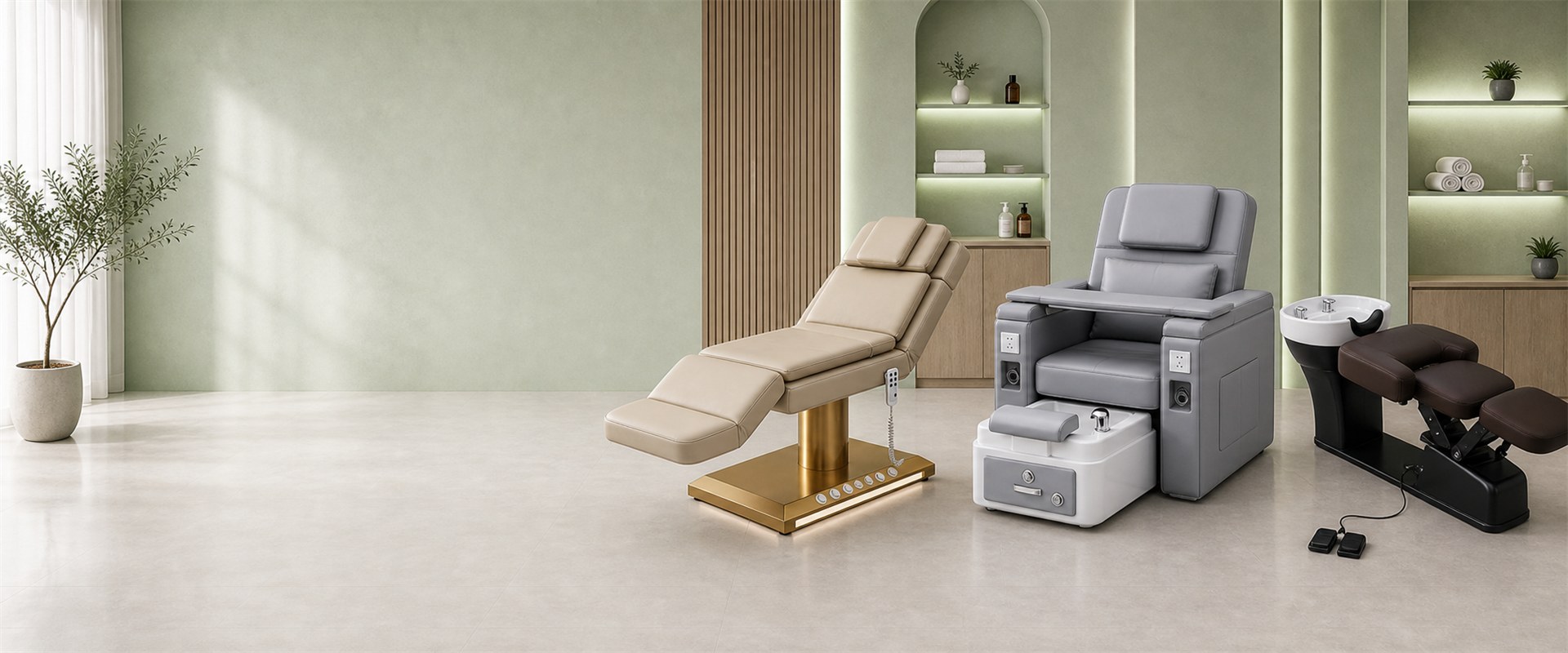
The most useful direction for 2026 is not a single color or shape. Buyers are planning furniture around the exact service journey: client entry, treatment position, operator access, tools, cleaning and exit. This creates different selection criteria for beauty treatment rooms, shampoo or head-spa areas and pedicure stations.
A service-led plan also improves purchasing discipline. It separates opening-critical products from furniture intended for possible future services. Salons can compare capacity and room fit before deciding which visual details matter, while distributors and project buyers can organize assortments by verified use case rather than broad lifestyle labels.
Trend 2: compact layouts require better evidence
Commercial space pressure encourages efficient layouts, but compact does not mean filling every available area. Buyers need verified model dimensions, operating clearance, technician movement and delivery access. A visually slim base or reclined product image cannot replace measured room planning.
Flexible planning is becoming more valuable than an unsupported promise that one model fits every room. Keep provisional zones around furniture until exact model data is confirmed. Record doorways, lifts, storage and supporting carts, and let the actual service sequence determine whether additional capacity is practical.
Trend 3: calm visual systems support brand consistency
Many salon concepts use restrained palettes, natural-looking textures and coordinated furniture to create a calm environment. The commercial lesson is to build a controlled finish schedule. Define core colors, secondary accents, brand references and the rooms where an exact match is important.
Customization must still be confirmed for each SKU and order. An image can inspire a palette but does not prove that every finish, logo position or accessory is available. Buyers should approve dated references and list which visible items are included. This protects the design intent when products come from several families or shipment phases.
Trend 4: operator workflow is part of the buying decision
Furniture is increasingly evaluated through repeated staff movement rather than client appearance alone. Buyers examine where the operator stands or sits, how often positions change, where controls and tools are located, and whether the furniture causes avoidable reaching or blocked access.
Turn ergonomic questions into model-level checks. Confirm adjustment method, moving sections and included controls where relevant. Observe the planned service sequence and supporting equipment. Terms such as electric, adjustable or luxury are not sufficient evidence of a workflow benefit without the exact configuration and room context.
Trend 5: cleaning and maintenance influence specification
Professional buyers are connecting furniture selection with daily cleaning, inspection and downtime planning. They review seams, surface divisions, removable supports, spaces around bases and access to service areas. The salon's actual oils, cosmetics and cleaning products should be considered before a material is approved.
Request available care information for the exact model and follow applicable manufacturer or supplier guidance. Do not convert a generic upholstery term into a durability or chemical-resistance claim. For chains and distributors, keep maintenance observations by SKU so repeat orders use real operating evidence rather than assumptions.
Trend 6: buyers demand traceable product information
A strong 2026 purchasing process uses SKU identity, current images, confirmed facts, missing fields and evidence dates. It separates product-family descriptions from model specifications. This is especially important when buyers compare many designs online and when similar-looking furniture may have different dimensions, components or site needs.
The same evidence discipline supports SEO, catalogs, quotations and repeat orders. A missing value should remain pending instead of being filled from a competitor or related model. Buyers benefit from fewer claims but clearer status, because room, freight and customization decisions can be tied to information that is actually reviewable.
Trend 7: total project coordination matters more than a product photo
Commercial buyers increasingly compare the full sourcing scope: product matching, customization, packing, export documentation, freight information and delivery coordination. A unit price or attractive room image cannot show which configuration is included or how the order reaches the destination.
Send YIO the buyer type, service plan, preferred product families, quantities, destination and project schedule. YIO can organize a model-specific comparison and quotation through its supplier network. The useful trend is a more controlled buying decision—one that connects design and operations with verified evidence rather than chasing novelty alone.
For distributors, chains and project teams, evaluate whether the chosen direction can be repeated without losing model identity or approval control. Preserve product records, finish references and change history. A trend becomes commercially valuable when it improves client experience and operations while remaining practical to source, document and maintain.
Review the selected direction after real use begins. Staff movement, cleaning time, client feedback and recurring product questions provide stronger evidence than a forecast alone. Use those observations to refine later rooms or purchase phases without rewriting verified SKU facts to match a design narrative.
FAQ
What is the most important salon furniture trend for 2026?
Service-led planning is the most practical direction: select furniture according to the client journey, operator workflow, room and verified model requirements.
Are neutral colors available on every salon furniture model?
No. Colors and finishes must be confirmed for the exact SKU, quantity and supplier before they become part of the approved design.
How should a buyer evaluate a compact salon layout?
Use verified dimensions, working clearance, supporting equipment and receiving access rather than judging scale from product photography.
Why is product evidence a salon furniture trend?
Traceable model facts reduce room, quotation, logistics and repeat-order errors and support more reliable commercial decisions.